Minor Arcana · Swords
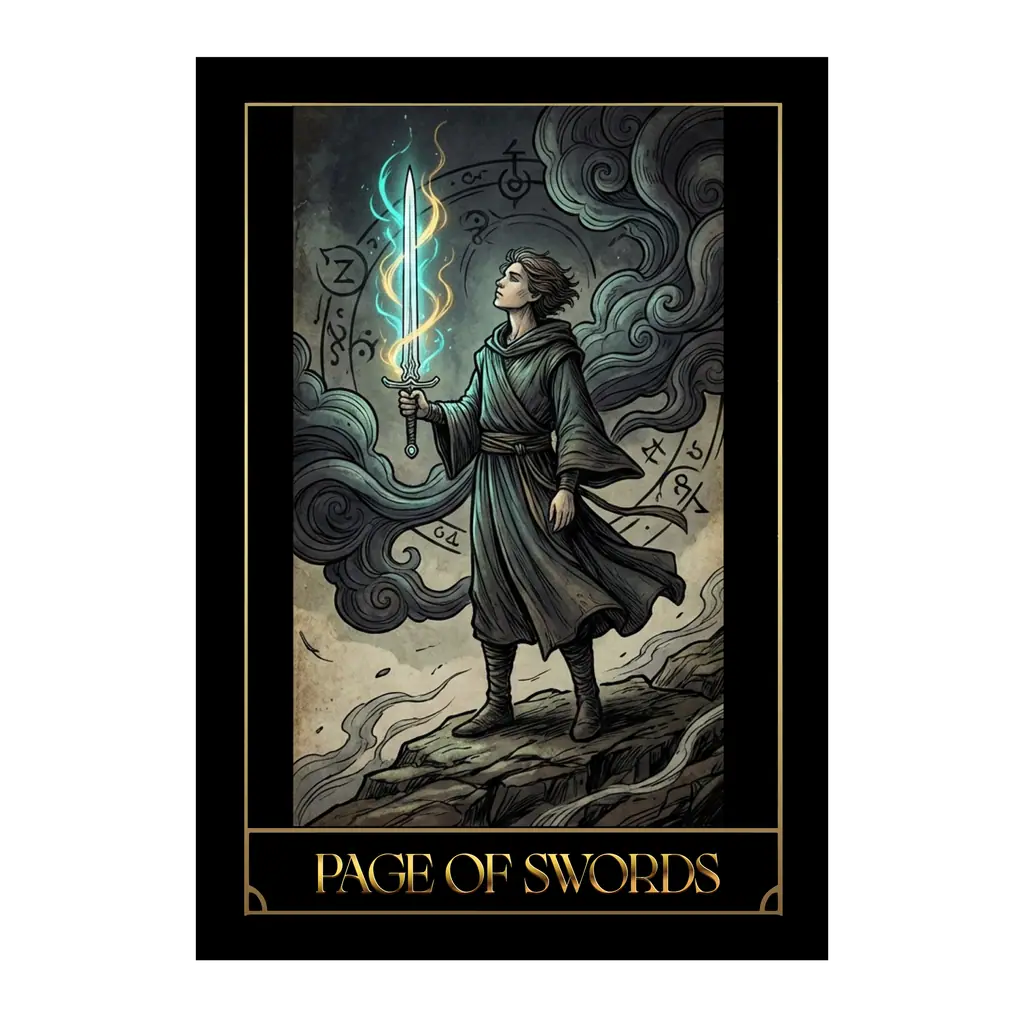
Page of Swords
A young figure stands on uneven ground holding a sword upright in both hands, looking back over one shoulder. The wind is up, the clouds are moving, and he is alert to something behind him. The Page of Swords is curiosity with an edge of vigilance. As a person, he is sharp, observant, quick to ask the question everyone else is being polite about, and not yet careful about the effect. As a situation, he is news that requires attention: information arriving, a question raised, something noticed. His strength is the willingness to be direct before he has learned not to be. Most useful questions are slightly rude, and by thirty most people have stopped asking them. The card's advice is usually to ask the blunt thing now rather than spend another fortnight constructing a version nobody could object to.
- Yes or no
- Maybe
- Position in the deck
- Card 61 of 78
Upright meaning
Curiosity, vigilance, and the direct question. Upright, the Page of Swords favours research, learning, and saying the thing everyone is dancing around. He often marks news or a sharp young person. Ask plainly — politeness has probably cost you two weeks already, and the answer is what you actually need.
Reversed meaning
Sharpness without aim. Reversed, the Page of Swords covers gossip, criticism for its own sake, information gathered and never used, and suspicion that has outrun the evidence. It can also mark someone with the question and not the nerve to ask it. Check whether you are investigating or just watching.
What the card offers
Ask the blunt question. Politeness has already cost you two weeks.
Page of Swords in love
Early conversations that matter more than they seem to. The Page of Swords favours asking directly what someone wants, and warns against the habit of reading messages for subtext instead of replying to them. Curiosity is attractive here; surveillance is not, and the line between them is thinner than it looks.
Page of Swords in work and career
Learning fast in a new field, and the value of the naive question. The Page of Swords favours analysis, research, writing, and roles where noticing things is the job. Ask the obvious question in the meeting. You are rarely the only person who does not know.
Page of Swords and wellbeing
Getting informed. The Page of Swords favours reading about the condition, preparing questions for the appointment, and paying attention to a symptom rather than dismissing it. Its failure mode is the search engine at midnight, which produces vigilance without any information you can use.
Page of Swords on the spiritual path
Questions before answers. The Page of Swords is the stage of interrogating a tradition rather than absorbing it — asking what a claim actually means and whether anyone has checked. That is not irreverence. It is the only kind of belief that holds up later.
Did Page of Swords show up in your question?
Draw it inside a spread and read it against the cards around it. Free, no sign-up, with a written interpretation.
Questions people ask about this card
What does Page of Swords mean upright?
Curiosity, vigilance, and the direct question. Upright, the Page of Swords favours research, learning, and saying the thing everyone is dancing around. He often marks news or a sharp young person. Ask plainly — politeness has probably cost you two weeks already, and the answer is what you actually need.
What does Page of Swords mean reversed?
Sharpness without aim. Reversed, the Page of Swords covers gossip, criticism for its own sake, information gathered and never used, and suspicion that has outrun the evidence. It can also mark someone with the question and not the nerve to ask it. Check whether you are investigating or just watching.
Is Page of Swords a yes or a no?
Page of Swords is a maybe — the answer depends on the surrounding cards. Ask the blunt question. Politeness has already cost you two weeks.
Written by
Truc MaiMore tarot guides
Love Tarot: What a Reading Can Actually Tell You
A love reading will not tell you whether they are the one. It will show you what you are bringing, what they are responding to, and where the connection is actually heading.
How to Ask Tarot a Good Question (Most People Get This Wrong)
Most disappointing tarot readings are not bad readings — they are good answers to badly built questions. Here is how to fix the question before you shuffle.
The Daily Tarot Card: A Practice That Actually Sticks
One card a day is the most useful tarot habit there is — and the easiest to abandon. Here is how to make it stick, and how to read a card that seems to say nothing.