Minor Arcana · Wands
Ten of Wands
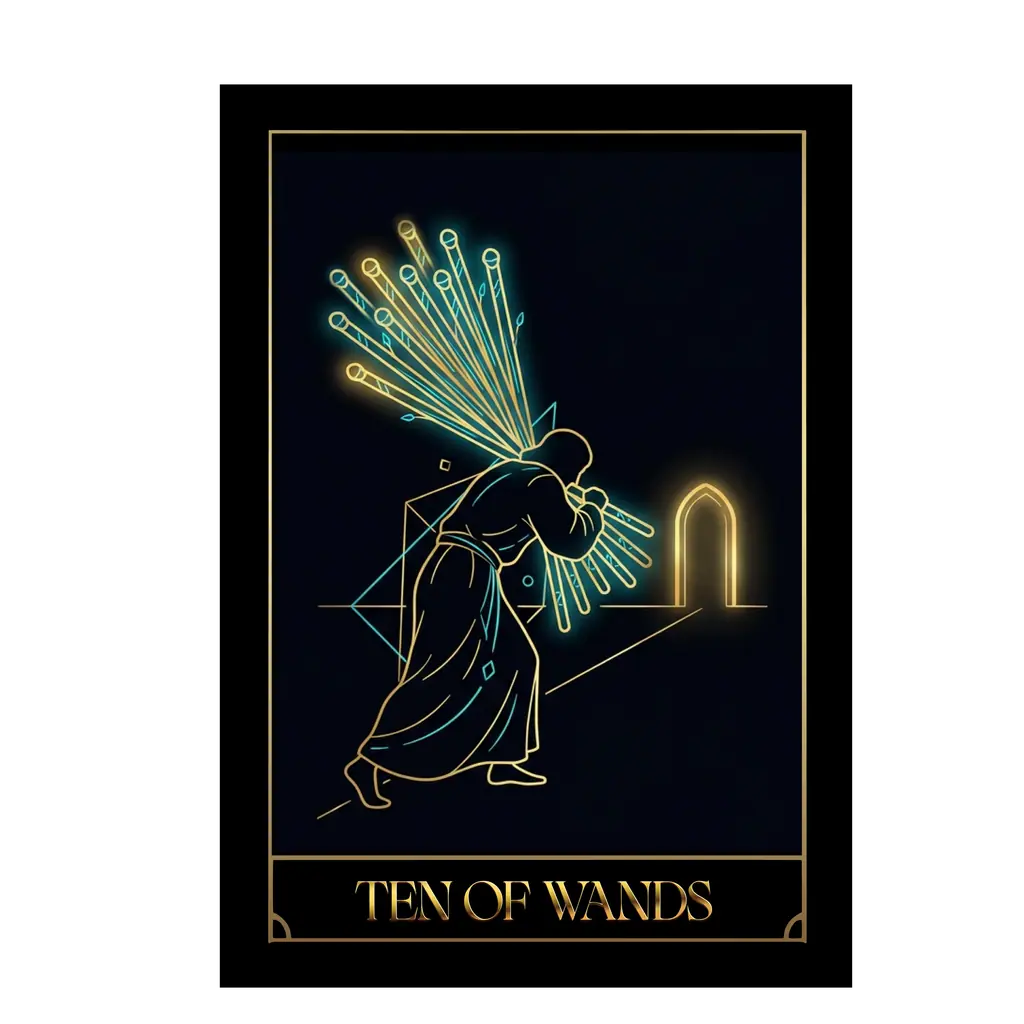
A man carries ten heavy staves bundled in front of him, bent so far forward that he cannot see where he is going. The town is close — you can see it in the background — and he cannot. The Ten of Wands is the burden that came from success. Each of those staves was once a good idea, a project worth taking on, a favour worth doing. Nothing here was imposed on him. He picked all of it up, one piece at a time, and never put any of it down. It appears when capability has become a trap: you are the person who can handle it, so you are handed more. The card is not asking you to work harder, and it is not asking you to quit. It is asking which of the ten is still worth carrying, because the answer is not ten, and because the destination is in sight and invisible from where you are standing.
- Yes or no
- No
- Position in the deck
- Card 32 of 78
Upright meaning
Overload, obligation, and the burden of your own competence. Upright, the Ten of Wands says the load is genuinely too heavy and that most of it was accepted voluntarily. It favours delegation, refusal, and finishing things rather than adding to them. Put something down deliberately, before something falls.
Reversed meaning
Either the load is being released or it is about to break you. Reversed, the Ten of Wands covers work handed over at last, responsibilities dropped in the wrong order, and the stubborn refusal to admit what carrying this is costing. It can also mark someone who has quietly offloaded their share onto other people.
What the card offers
Put something down. Carrying all of it is not the same as finishing it.
Ten of Wands in love
A relationship in which one person is doing most of the carrying — emotionally, practically, or both. The Ten of Wands rarely describes cruelty. It describes drift, where competence in one partner became a permanent arrangement. Name the imbalance specifically, item by item, rather than as a complaint about effort.
Ten of Wands in work and career
Too much, taken on for good reasons. The Ten of Wands is the card of the reliable person at the point of failure. It favours saying no, handing work over, and finishing open items before starting anything new. Your reward for absorbing more work has been more work; that pattern stops only when you stop it.
Ten of Wands and wellbeing
Exhaustion with a cause you can list. The Ten of Wands is stress-carried-in-the-body — back, shoulders, jaw, sleep. There is no supplement for this one. The card is unusually literal: the intervention is removing load, and nothing else will substitute for it.
Ten of Wands on the spiritual path
A practice that has become another obligation. The Ten of Wands shows up when the thing meant to sustain you has acquired a schedule, a target, and a quiet sense of failure attached. Do less of it, and less rigorously, until it is something you want to do again.
Did Ten of Wands show up in your question?
Draw it inside a spread and read it against the cards around it. Free, no sign-up, with a written interpretation.
Questions people ask about this card
What does Ten of Wands mean upright?
Overload, obligation, and the burden of your own competence. Upright, the Ten of Wands says the load is genuinely too heavy and that most of it was accepted voluntarily. It favours delegation, refusal, and finishing things rather than adding to them. Put something down deliberately, before something falls.
What does Ten of Wands mean reversed?
Either the load is being released or it is about to break you. Reversed, the Ten of Wands covers work handed over at last, responsibilities dropped in the wrong order, and the stubborn refusal to admit what carrying this is costing. It can also mark someone who has quietly offloaded their share onto other people.
Is Ten of Wands a yes or a no?
Ten of Wands leans towards no. Put something down. Carrying all of it is not the same as finishing it.
Written by
Truc MaiMore tarot guides
Love Tarot: What a Reading Can Actually Tell You
A love reading will not tell you whether they are the one. It will show you what you are bringing, what they are responding to, and where the connection is actually heading.
How to Ask Tarot a Good Question (Most People Get This Wrong)
Most disappointing tarot readings are not bad readings — they are good answers to badly built questions. Here is how to fix the question before you shuffle.
The Daily Tarot Card: A Practice That Actually Sticks
One card a day is the most useful tarot habit there is — and the easiest to abandon. Here is how to make it stick, and how to read a card that seems to say nothing.