Minor Arcana · Swords
Eight of Swords
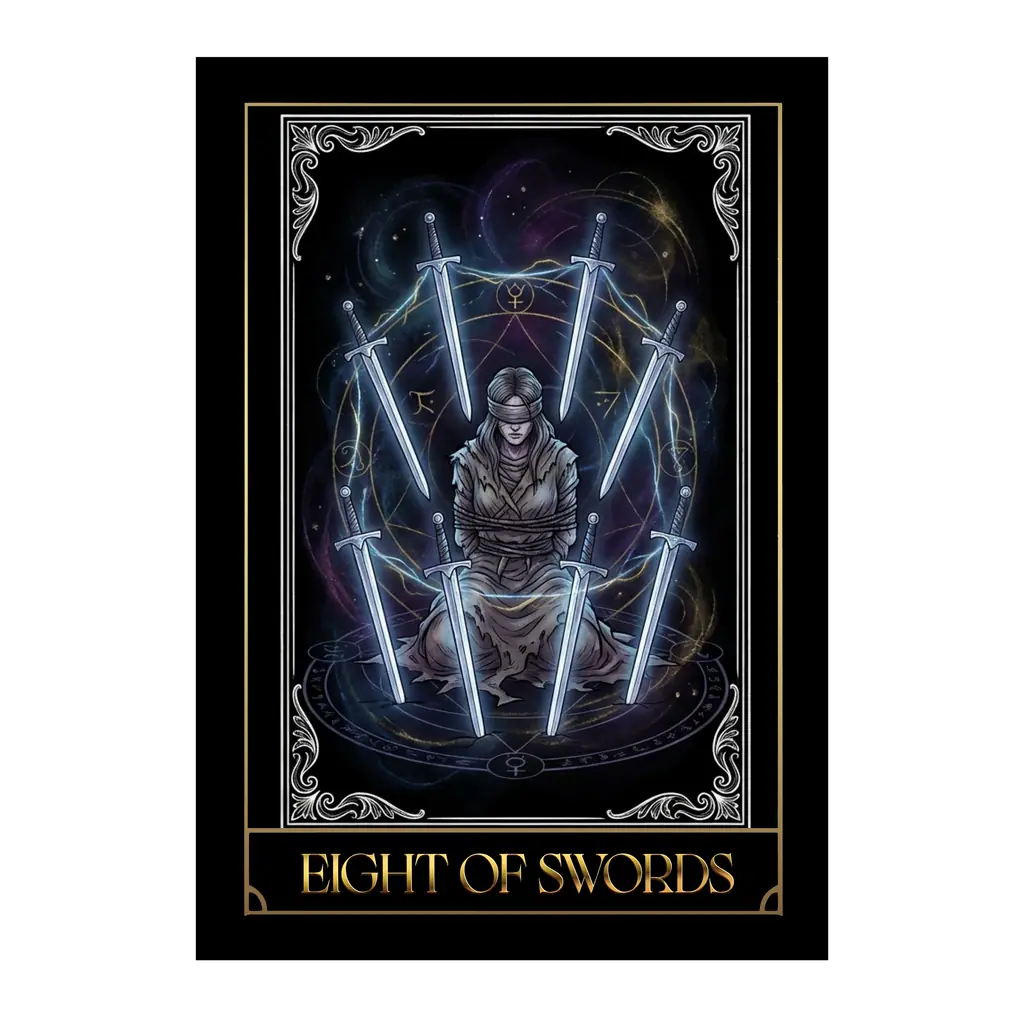
A woman stands bound and blindfolded among eight swords stuck in the ground. The swords do not form a circle — there is a clear gap behind her — and the bindings are loose. She is not looking, so she does not know. The Eight of Swords is a trap made mostly of belief. The constraints are real in the sense that she experiences them, and unreal in the sense that they are not what is holding her. It appears when someone describes a situation as impossible using a set of assumptions nobody has tested for years. The card is careful not to be glib about this. Being told you are free when you feel trapped is useless. What it offers instead is a method: test one thing. Not the whole cage, not the identity built around it — one bar. Most of them turn out to be assumptions, and the ones that are not become much easier to work on once you know which they are.
- Yes or no
- No
- Position in the deck
- Card 58 of 78
Upright meaning
Feeling trapped by constraints that are largely self-maintained. Upright, the Eight of Swords covers helplessness, catastrophic thinking, and a situation that is genuinely restrictive and less total than it feels. Test one assumption this week. The cage is real and it has a gap in it you have not looked for.
Reversed meaning
The bindings loosen. Reversed, the Eight of Swords marks the beginning of getting free — seeing the pattern, asking for help, finding out that a limit was never enforced. Less often it marks restriction deepening into resignation. Either way, the card has moved from feeling to fact.
What the card offers
Test one bar of the cage. Most of them are assumptions.
Eight of Swords in love
Staying because leaving seems impossible. The Eight of Swords covers relationships held together by fear of the alternative, and the specific paralysis of someone who has stopped being able to imagine another arrangement. Name one concrete thing that would have to be true to leave. Then check whether it is.
Eight of Swords in work and career
A job you believe you cannot leave. The Eight of Swords covers golden handcuffs, imposter syndrome, and constraints repeated so often they stopped being examined. Test the actual numbers rather than the feeling. People routinely overestimate what they cannot afford and underestimate what they are worth.
Eight of Swords and wellbeing
Anxiety that restricts, and the narrowing of life that follows it. The Eight of Swords is one of the clearest anxiety cards in the deck. The intervention it favours is small and specific rather than sweeping — one bar, tested, not the whole cage examined at once.
Eight of Swords on the spiritual path
Beliefs that confine. The Eight of Swords covers doctrines, family scripts and inherited certainties that have become the walls of the available world. Examining one of them is not betrayal. It is the only way to find out which of them you actually hold.
Did Eight of Swords show up in your question?
Draw it inside a spread and read it against the cards around it. Free, no sign-up, with a written interpretation.
Questions people ask about this card
What does Eight of Swords mean upright?
Feeling trapped by constraints that are largely self-maintained. Upright, the Eight of Swords covers helplessness, catastrophic thinking, and a situation that is genuinely restrictive and less total than it feels. Test one assumption this week. The cage is real and it has a gap in it you have not looked for.
What does Eight of Swords mean reversed?
The bindings loosen. Reversed, the Eight of Swords marks the beginning of getting free — seeing the pattern, asking for help, finding out that a limit was never enforced. Less often it marks restriction deepening into resignation. Either way, the card has moved from feeling to fact.
Is Eight of Swords a yes or a no?
Eight of Swords leans towards no. Test one bar of the cage. Most of them are assumptions.
Written by
Truc MaiMore tarot guides
Love Tarot: What a Reading Can Actually Tell You
A love reading will not tell you whether they are the one. It will show you what you are bringing, what they are responding to, and where the connection is actually heading.
How to Ask Tarot a Good Question (Most People Get This Wrong)
Most disappointing tarot readings are not bad readings — they are good answers to badly built questions. Here is how to fix the question before you shuffle.
The Daily Tarot Card: A Practice That Actually Sticks
One card a day is the most useful tarot habit there is — and the easiest to abandon. Here is how to make it stick, and how to read a card that seems to say nothing.