Minor Arcana · Swords
Six of Swords
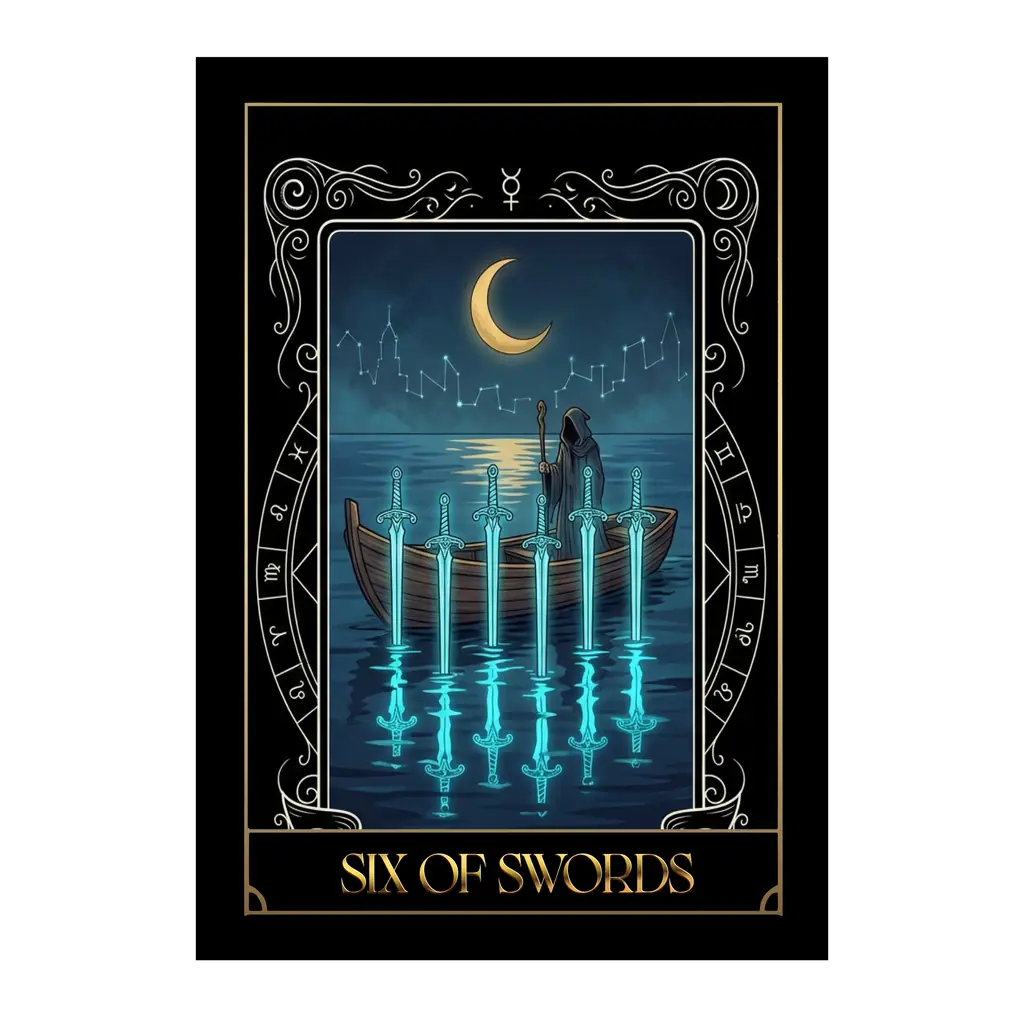
A ferryman poles a boat across still water, carrying a cloaked woman and a child, six swords standing upright in the bow. The water ahead is smooth and the water behind is choppy. Nobody in the boat looks happy. The Six of Swords is a transition away from something difficult, undertaken without enthusiasm. It is the move, the separation, the change of job that had to happen. The swords come along — the trouble is not left behind, it is being carried somewhere it can be dealt with. What the card gets right is the emotional register. This is not escape or triumph; it is the flat, tired competence of doing the sensible thing. You do not have to feel better before you leave, and you will probably not feel better for a while afterwards. The card only says the water ahead is calmer, and it means it.
- Yes or no
- Maybe
- Position in the deck
- Card 56 of 78
Upright meaning
A necessary move toward somewhere calmer. Upright, the Six of Swords favours transitions, travel, leaving a difficult situation, and recovery that happens by changing circumstances rather than by resolving them. Go. You do not have to feel ready, and you will not feel triumphant — the card does not promise that part.
Reversed meaning
The crossing is stalled. Reversed, the Six of Swords covers being unable to leave, returning to what you left, and transitions made physically but not emotionally. It can also mark baggage carried that should have been put down. Check what you brought that did not need to come.
What the card offers
Go somewhere quieter. You do not have to feel better before you leave.
Six of Swords in love
Moving on, slowly and without drama. The Six of Swords covers the period after a separation where things are simply quieter, and relationships that survive by relocating — literally or otherwise. It is not a card of resolution. It is a card of distance, which sometimes does the same work.
Six of Swords in work and career
A change of role, employer or city, made to get out of something rather than toward something. The Six of Swords says that is a legitimate reason. The improvement will be real and undramatic, and the skills you are carrying come with you even when the situation does not.
Six of Swords and wellbeing
Gradual recovery after a bad stretch. The Six of Swords is the convalescent phase where nothing is acute and nothing is fixed. It favours a change of environment, and it asks for patience with a timeline measured in months rather than in resolutions.
Six of Swords on the spiritual path
Leaving without a destination yet. The Six of Swords is the honest middle of a change of belief — the old framework no longer holds and the new one has not arrived. That gap is not failure. It is what the crossing looks like from inside the boat.
Did Six of Swords show up in your question?
Draw it inside a spread and read it against the cards around it. Free, no sign-up, with a written interpretation.
Questions people ask about this card
What does Six of Swords mean upright?
A necessary move toward somewhere calmer. Upright, the Six of Swords favours transitions, travel, leaving a difficult situation, and recovery that happens by changing circumstances rather than by resolving them. Go. You do not have to feel ready, and you will not feel triumphant — the card does not promise that part.
What does Six of Swords mean reversed?
The crossing is stalled. Reversed, the Six of Swords covers being unable to leave, returning to what you left, and transitions made physically but not emotionally. It can also mark baggage carried that should have been put down. Check what you brought that did not need to come.
Is Six of Swords a yes or a no?
Six of Swords is a maybe — the answer depends on the surrounding cards. Go somewhere quieter. You do not have to feel better before you leave.
Written by
Truc MaiMore tarot guides
Love Tarot: What a Reading Can Actually Tell You
A love reading will not tell you whether they are the one. It will show you what you are bringing, what they are responding to, and where the connection is actually heading.
How to Ask Tarot a Good Question (Most People Get This Wrong)
Most disappointing tarot readings are not bad readings — they are good answers to badly built questions. Here is how to fix the question before you shuffle.
The Daily Tarot Card: A Practice That Actually Sticks
One card a day is the most useful tarot habit there is — and the easiest to abandon. Here is how to make it stick, and how to read a card that seems to say nothing.