Minor Arcana · Swords
Seven of Swords
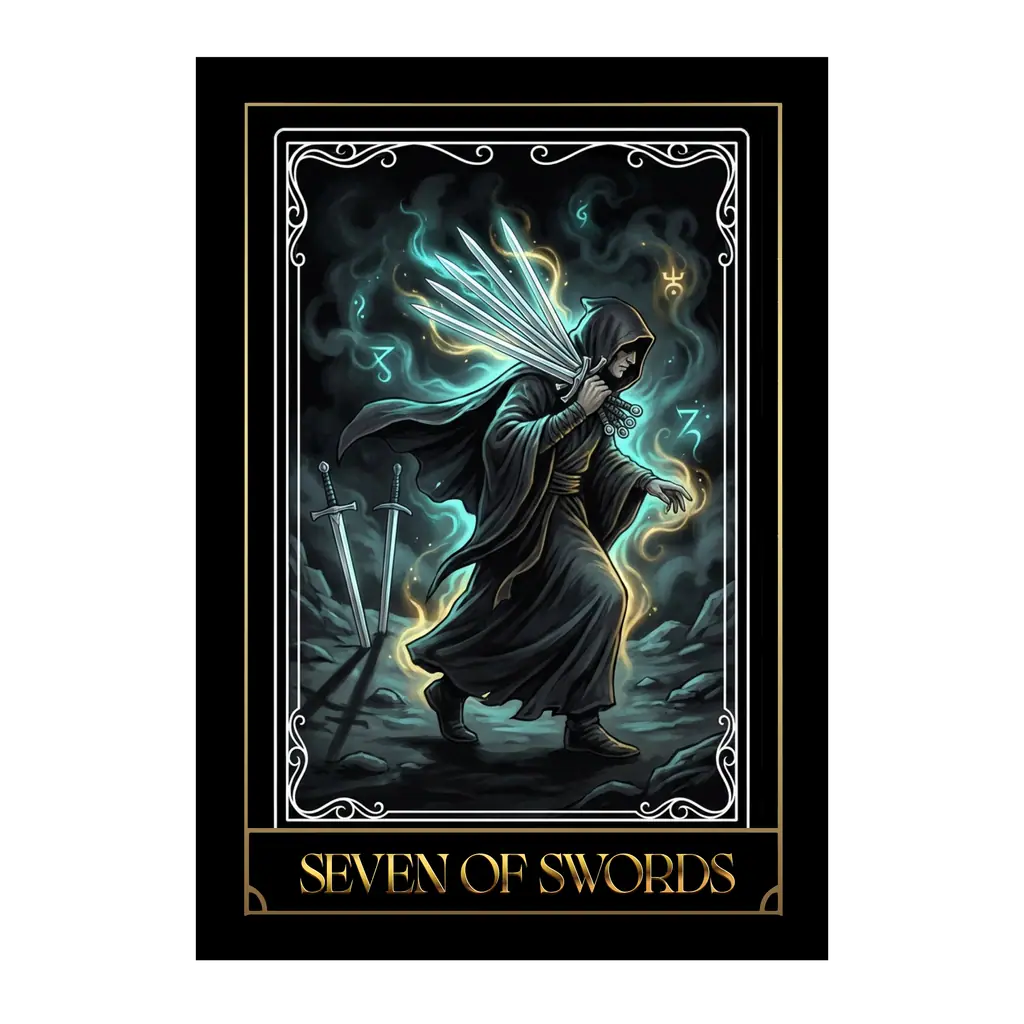
A man walks away from a camp carrying five swords, glancing over his shoulder, leaving two behind. He is pleased with himself and he has not thought it through — he is holding the blades by the sharp end and he did not take all of them. The Seven of Swords is the clever shortcut. Cutting a corner, taking what is not yours, working around a rule, handling something by not mentioning it. It is not a card of grand villainy; it is the small strategic dishonesty that people use when the direct route looks too costly. The two abandoned swords are the card's argument. Shortcuts are incomplete by nature, and the part left behind is usually the part that surfaces later. Its test is simple and harder than it sounds: take the clever route only if you could explain it out loud to the person it affects.
- Yes or no
- No
- Position in the deck
- Card 57 of 78
Upright meaning
Stealth, strategy, and getting around something rather than through it. Upright, the Seven of Swords covers cutting corners, withholding information, and acting alone where cooperation was expected. It can be the right move. Apply the test — if you could not say it plainly to the people involved, it is the wrong one.
Reversed meaning
Exposure or confession. Reversed, the Seven of Swords covers being found out, coming clean, and the return of something taken. It can also mark self-deception rather than deception of others, or a person who suspects they are being worked around and is right. The concealed thing is becoming visible.
What the card offers
Take the clever route only if you could explain it out loud.
Seven of Swords in love
Something is not being said. The Seven of Swords covers secrets, half-truths, and the management of a relationship through selective disclosure. It rarely indicates a dramatic betrayal. It indicates the smaller and more corrosive habit of handling someone rather than talking to them.
Seven of Swords in work and career
Office politics, credit quietly redirected, work done around a process rather than through it. The Seven of Swords also covers your own strategic behaviour. Independent action is fine; unexplained independent action is what damages people. Decide which one this is before doing it.
Seven of Swords and wellbeing
Not telling the whole truth — to the doctor, to yourself, to the people around you. The Seven of Swords is the omitted symptom and the private habit. Whatever you are leaving out of the account is usually the item that matters most in it.
Seven of Swords on the spiritual path
Self-deception. The Seven of Swords is the practice performed for an audience, the principle applied selectively, the story about yourself that has a convenient gap in it. Honesty here is not confession to anyone else; it is refusing to hold the sword by the blade and call it a plan.
Did Seven of Swords show up in your question?
Draw it inside a spread and read it against the cards around it. Free, no sign-up, with a written interpretation.
Questions people ask about this card
What does Seven of Swords mean upright?
Stealth, strategy, and getting around something rather than through it. Upright, the Seven of Swords covers cutting corners, withholding information, and acting alone where cooperation was expected. It can be the right move. Apply the test — if you could not say it plainly to the people involved, it is the wrong one.
What does Seven of Swords mean reversed?
Exposure or confession. Reversed, the Seven of Swords covers being found out, coming clean, and the return of something taken. It can also mark self-deception rather than deception of others, or a person who suspects they are being worked around and is right. The concealed thing is becoming visible.
Is Seven of Swords a yes or a no?
Seven of Swords leans towards no. Take the clever route only if you could explain it out loud.
Written by
Truc MaiMore tarot guides
Love Tarot: What a Reading Can Actually Tell You
A love reading will not tell you whether they are the one. It will show you what you are bringing, what they are responding to, and where the connection is actually heading.
How to Ask Tarot a Good Question (Most People Get This Wrong)
Most disappointing tarot readings are not bad readings — they are good answers to badly built questions. Here is how to fix the question before you shuffle.
The Daily Tarot Card: A Practice That Actually Sticks
One card a day is the most useful tarot habit there is — and the easiest to abandon. Here is how to make it stick, and how to read a card that seems to say nothing.