Minor Arcana · Wands
Five of Wands
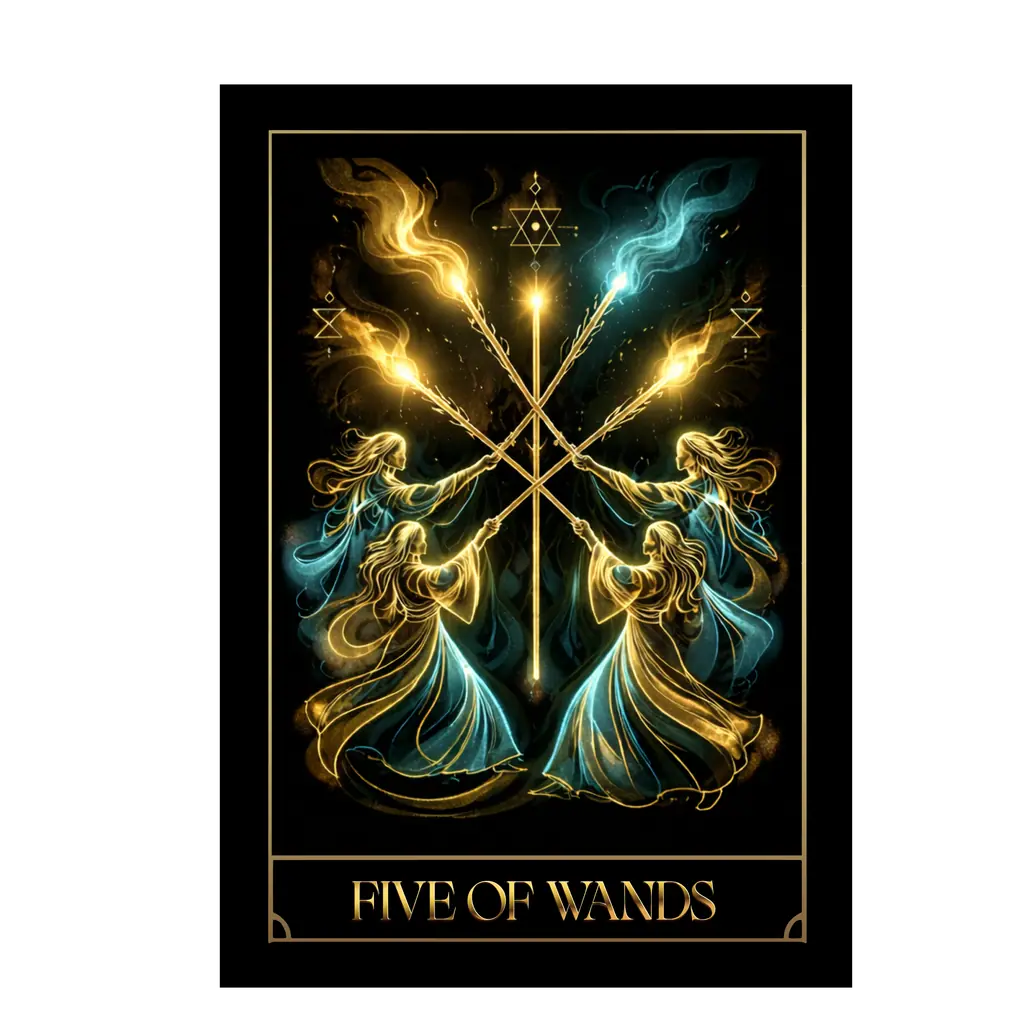
Five young figures brandish staves at each other in an open field. Nobody is hurt, nobody is on the ground, and the poses are more athletic than violent. Waite's own reading of the image is contest rather than battle — this is a scrum, not a war. The Five of Wands describes friction between people who mostly want the same thing. Competing proposals, a crowded market, a team where everyone has an opinion and nobody has authority, a family arguing about a decision nobody actually opposes. The noise is real and the stakes are usually smaller than the volume implies. Its value is that the friction is productive if it is kept on the idea. Ideas improve under challenge. People do not improve under attack, and the card sits exactly on the line between the two — which is why it appears when a disagreement is about to become personal.
- Yes or no
- Maybe
- Position in the deck
- Card 27 of 78
Upright meaning
Competition, disagreement, and a crowded field. Upright, the Five of Wands favours environments where you have to argue for your position: pitches, interviews, teams still forming, markets with real rivals. It is tiring rather than dangerous. Fight the idea, keep the person, and expect the result to be better for the fight.
Reversed meaning
The conflict has gone underground, or gone personal. Reversed, the Five of Wands covers arguments avoided until they fester, competition that has turned into resentment, and the exhaustion of a group that fights about everything except the actual problem. It can also mark a truce that resolved nothing.
What the card offers
This is friction, not war. Argue the idea and keep the people.
Five of Wands in love
Friction that is not a crisis: bickering, competing needs, two people who are both tired and both right. The Five of Wands says this is ordinary and worth handling before it calcifies. Argue about the specific thing. Relationships rarely fail on the subject of the argument; they fail on how it is conducted.
Five of Wands in work and career
A crowded, competitive stretch — multiple candidates, a team without clear ownership, several projects pulling at the same resource. The Five of Wands favours people who can hold a position without needing to win every exchange. Make your case once, properly, and stop relitigating it in every meeting.
Five of Wands and wellbeing
Scattered effort and the irritability that comes with it. The Five of Wands often shows up as too many competing demands producing poor sleep and short temper rather than as any specific ailment. Physical competition suits this card. So does deciding which two of the five demands are real.
Five of Wands on the spiritual path
Doubt that argues back. The Five of Wands is the stage where a practice or a belief gets tested — by other people, by contradiction, by your own scepticism. This is not a failure of faith. Convictions that have never been argued with are just inherited opinions.
Did Five of Wands show up in your question?
Draw it inside a spread and read it against the cards around it. Free, no sign-up, with a written interpretation.
Questions people ask about this card
What does Five of Wands mean upright?
Competition, disagreement, and a crowded field. Upright, the Five of Wands favours environments where you have to argue for your position: pitches, interviews, teams still forming, markets with real rivals. It is tiring rather than dangerous. Fight the idea, keep the person, and expect the result to be better for the fight.
What does Five of Wands mean reversed?
The conflict has gone underground, or gone personal. Reversed, the Five of Wands covers arguments avoided until they fester, competition that has turned into resentment, and the exhaustion of a group that fights about everything except the actual problem. It can also mark a truce that resolved nothing.
Is Five of Wands a yes or a no?
Five of Wands is a maybe — the answer depends on the surrounding cards. This is friction, not war. Argue the idea and keep the people.
Written by
Truc MaiMore tarot guides
Love Tarot: What a Reading Can Actually Tell You
A love reading will not tell you whether they are the one. It will show you what you are bringing, what they are responding to, and where the connection is actually heading.
How to Ask Tarot a Good Question (Most People Get This Wrong)
Most disappointing tarot readings are not bad readings — they are good answers to badly built questions. Here is how to fix the question before you shuffle.
The Daily Tarot Card: A Practice That Actually Sticks
One card a day is the most useful tarot habit there is — and the easiest to abandon. Here is how to make it stick, and how to read a card that seems to say nothing.