Minor Arcana · Swords
Four of Swords
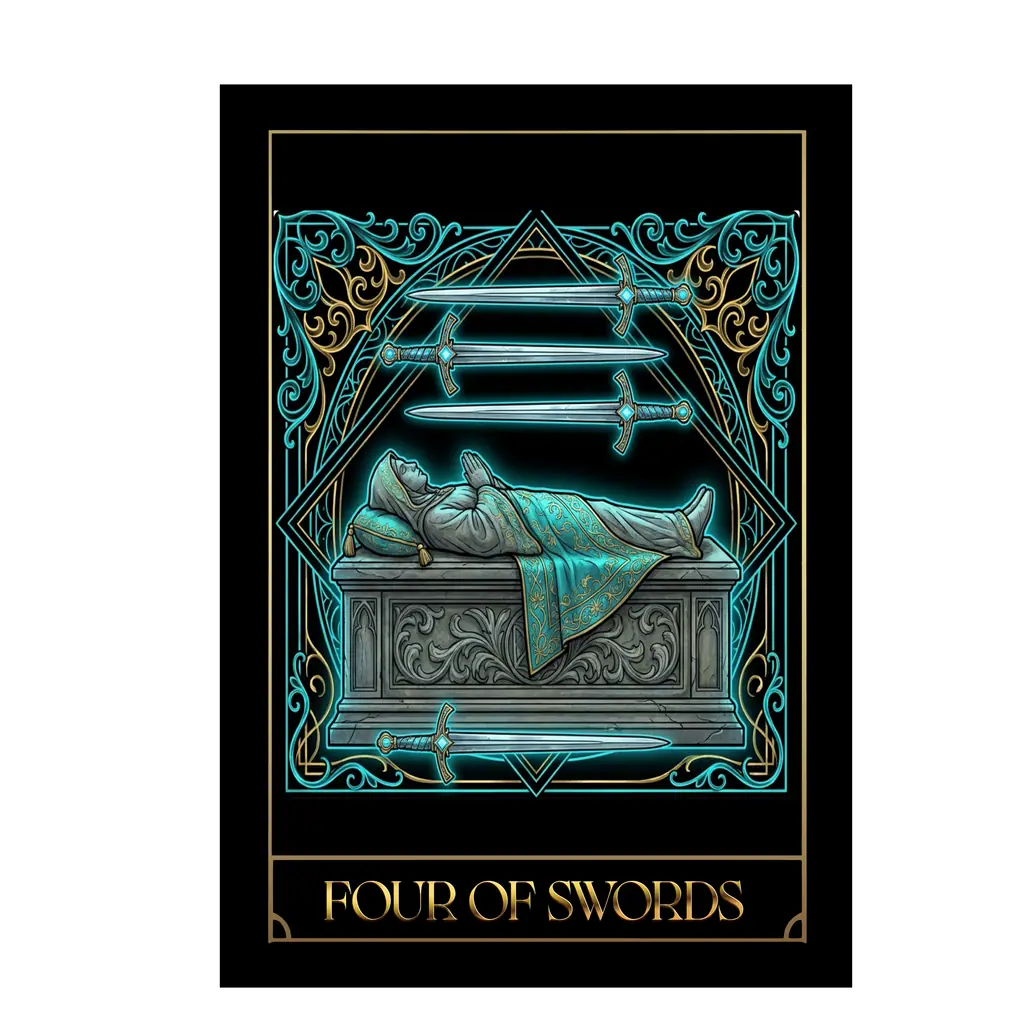
A knight lies in effigy on a tomb, hands together, with three swords fixed on the wall above and one lying beneath him. A stained-glass window shows a figure at prayer. Nothing is happening, deliberately. The Four of Swords is enforced rest after the Three. It is not defeat and it is not sleep — it is the pause a body and mind take because the alternative is breaking. It appears after crises, during recovery, and at the point in a long effort where continuing has stopped producing anything. The three swords on the wall matter: the conflicts are still there, put aside rather than resolved. This card does not ask you to solve anything. It asks you to stop, on the grounds that nothing decided in your current state will hold, and that rest is a precondition for the next move rather than a reward for the last one.
- Yes or no
- No
- Position in the deck
- Card 54 of 78
Upright meaning
Rest, retreat, and recovery that is not optional. Upright, the Four of Swords favours stepping back, sleeping properly, and postponing decisions until you are capable of making them well. It is a card of recuperation rather than avoidance. Stop. Nothing you decide while this tired will hold.
Reversed meaning
Rest refused or overextended. Reversed, the Four of Swords covers burnout from pushing through, restlessness that will not allow a pause, and the opposite — a retreat that has quietly become permanent. It can also mark the return to activity after a long recovery. Check which way you are moving.
What the card offers
Stop. Nothing you decide while this tired will hold.
Four of Swords in love
Distance taken on purpose. The Four of Swords covers relationships that need space rather than resolution, and periods where one person has nothing left to give. It is not a breakup card. It asks for a genuine pause instead of a conversation conducted by two exhausted people.
Four of Swords in work and career
Take the leave. The Four of Swords appears when someone is working through something that requires stopping — illness, grief, or simple depletion. It also favours strategic withdrawal: stepping out of a conflict rather than winning it. The work will survive your absence better than it will survive your collapse.
Four of Swords and wellbeing
Convalescence, and the direct instruction to rest. The Four of Swords is one of the most literal cards in the deck on health questions. Sleep, medical rest, recovery time. It warns specifically against the pattern of returning at eighty per cent and relapsing at forty.
Four of Swords on the spiritual path
Silence and retreat. The Four of Swords favours stillness with no productive aim attached — not meditation as self-improvement, but simply stopping. What arrives in that gap tends not to arrive any other way, and it cannot be scheduled efficiently.
Did Four of Swords show up in your question?
Draw it inside a spread and read it against the cards around it. Free, no sign-up, with a written interpretation.
Questions people ask about this card
What does Four of Swords mean upright?
Rest, retreat, and recovery that is not optional. Upright, the Four of Swords favours stepping back, sleeping properly, and postponing decisions until you are capable of making them well. It is a card of recuperation rather than avoidance. Stop. Nothing you decide while this tired will hold.
What does Four of Swords mean reversed?
Rest refused or overextended. Reversed, the Four of Swords covers burnout from pushing through, restlessness that will not allow a pause, and the opposite — a retreat that has quietly become permanent. It can also mark the return to activity after a long recovery. Check which way you are moving.
Is Four of Swords a yes or a no?
Four of Swords leans towards no. Stop. Nothing you decide while this tired will hold.
Written by
Truc MaiMore tarot guides
Love Tarot: What a Reading Can Actually Tell You
A love reading will not tell you whether they are the one. It will show you what you are bringing, what they are responding to, and where the connection is actually heading.
How to Ask Tarot a Good Question (Most People Get This Wrong)
Most disappointing tarot readings are not bad readings — they are good answers to badly built questions. Here is how to fix the question before you shuffle.
The Daily Tarot Card: A Practice That Actually Sticks
One card a day is the most useful tarot habit there is — and the easiest to abandon. Here is how to make it stick, and how to read a card that seems to say nothing.